I build useful software end to end: web apps, data pipelines and AI features.
5 years building products that combine web applications, data pipelines and AI. Today I build the data pipelines and analytics dashboards that ExxonMobil's trading teams rely on. Before that, I shipped LLM-powered enrichment and an agent chat for an AI platform in private markets. On the side, I build and run websites for small businesses in Brazil.

Experience
-
ExxonMobil
Full Stack EngineerInternal analytics tools for the company's global trading organization.
- Worked with traders and analysts to turn slow legacy workflows into self-service dashboards for local, regional and global teams.
- Owned each dashboard end to end, from data pipelines to UI (Python, React, Databricks), giving analysts one reliable view of data from several sources.
-
Klever AI
Full Stack EngineerAI platform that helps family offices de-risk deals through the experts and co-investors in their network.
- Built an interactive network graph of each family office's relationships, paired with an AI agent chat to explore it (React, GraphQL, Node.js).
- Built the data collection and LLM enrichment pipeline behind expert and co-investor matching, and wrote most of the prompts for background AI jobs (Python, MongoDB, OpenAI).
-
ConvertaX
Full Stack EngineerManagement platform for telemarketing companies' operations and sales teams.
- Built the management dashboards supervisors used to track their products and team performance.
- Designed and maintained the backend services and AWS infrastructure behind the platform (NestJS).
-
BI Labs
Full Stack EngineerTechnology consulting firm delivering web apps, data pipelines and automations.
- Delivered web applications from requirements to production for clients in crypto, agribusiness, HR and recycling (Next.js, React, NestJS).
- Replaced clients' manual data collection with scraping and ETL automations (Python).
Tools
- Languages
- TypeScript, JavaScript, Python, SQL
- Frontend
- React, Next.js, Vite, Zustand, Highcharts, Recharts
- Backend
- Node.js, NestJS, FastAPI, GraphQL, REST, Prisma, Redis
- Data
- Databricks, Pandas, PostgreSQL, MongoDB, Snowflake, CosmosDB
- AI
- LLMs, RAG, AI agents, MCP, LangChain, LlamaIndex, OpenAI, Gemini
- Cloud, tests
- AWS, Docker, Vercel, Jest, Vitest, Cypress, Pytest, Playwright
Case study
Websites for small businesses, built and run solo
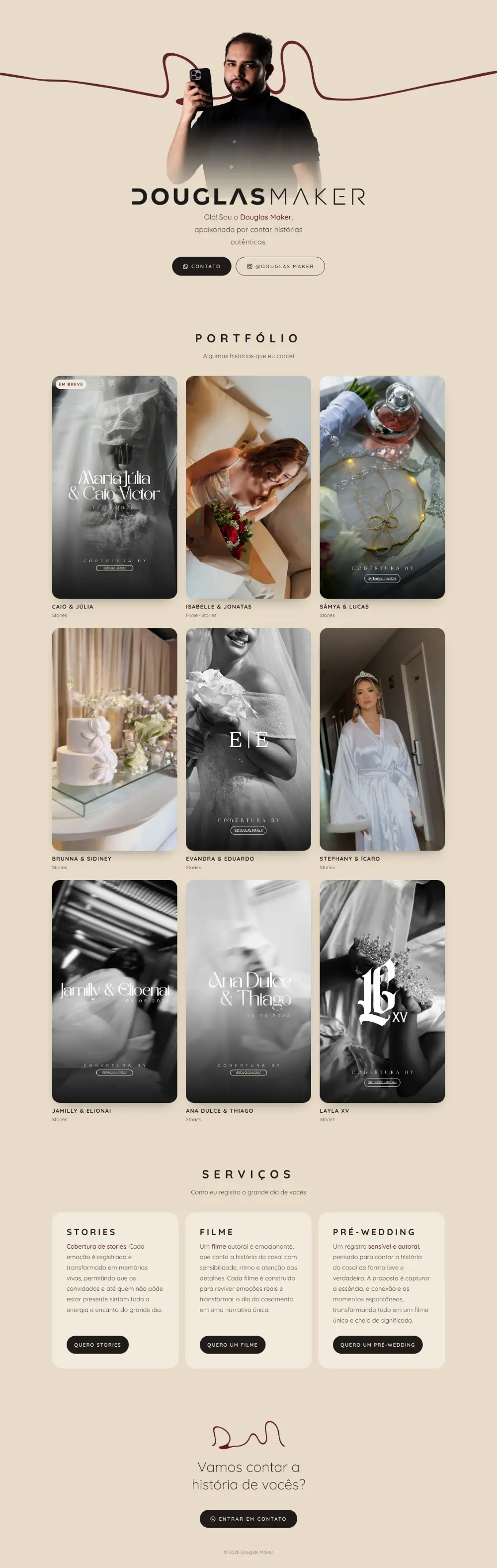
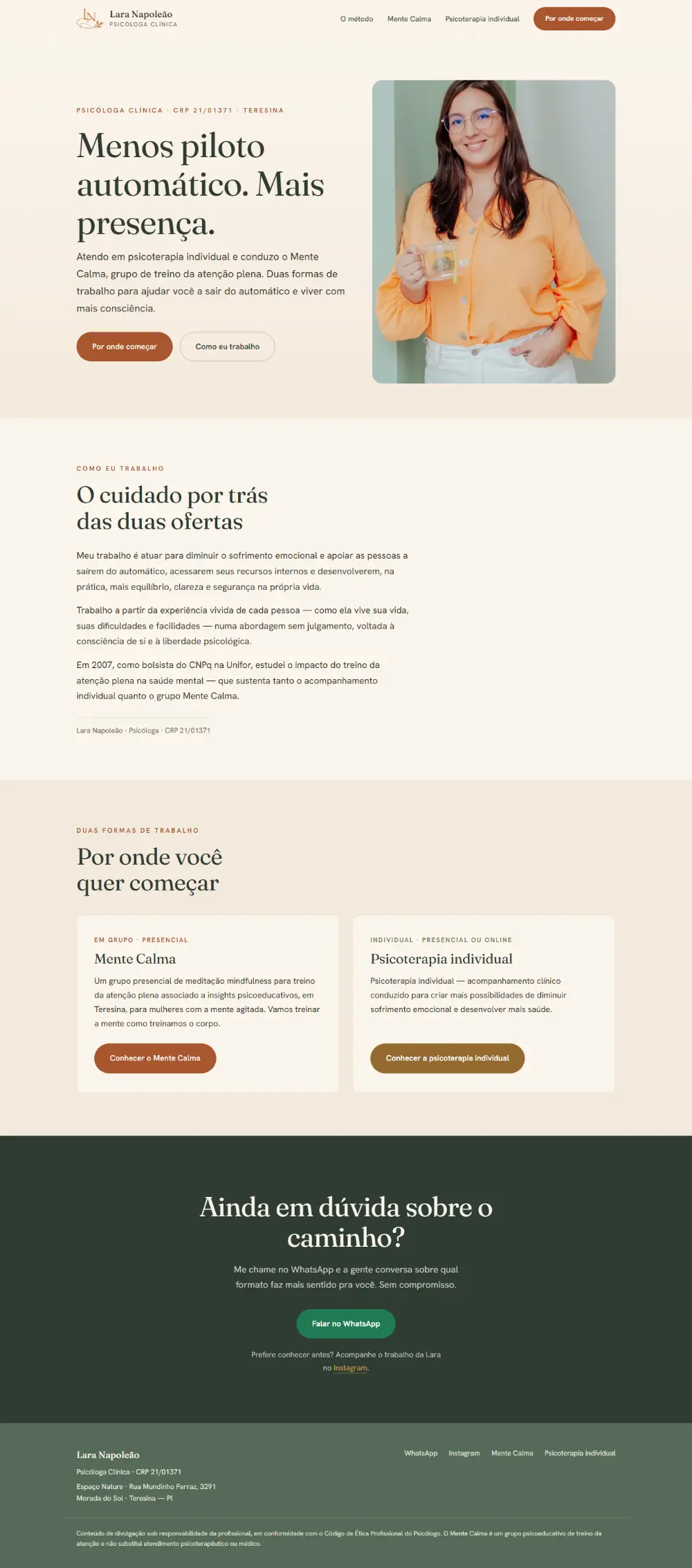
My clients are wedding vendors, a psychologist and couples in Brazil. They find clients on Instagram and close deals on WhatsApp. They need a site that looks as good as their work, sends every lead to their WhatsApp, and can be changed for a year without them touching code. I build and maintain all of it alone, so every site has to stay cheap to run and easy for one person to change.


Architecture
- One data file per clientevents, prices, texts, WhatsApp
- Node generatorone page per event, quote links per year and service
- Static pages, committedno framework, no build on deploy
- git push → Vercelpreview per branch, production on master
- Playwright testslocally and against the live URL
- Wedding films are self-hosted on Cloudflare R2 with a custom player, because YouTube blocks some of them over the music.
- Every button opens the client's WhatsApp through
wa.me, with the lead's source written into the message.
Problems worth telling
- Lead attribution without analytics. Each channel gets its own
?utm_source=link, and the WhatsApp message the visitor sends already says where they came from. The buttons keep a static fallback, so they work without JavaScript. - Link previews that sell. Each event page has its own Open Graph image and title, so a link sent to a couple on WhatsApp shows the right wedding.
- Regulated copy. The psychologist's site follows the Federal Council of Psychology's advertising rules: no promised results, no patient testimonials, registration number always visible.
- A gift registry that became a product. My own wedding site turned into a white-label template, with one fork per couple. It runs on Vercel serverless functions and Upstash Redis. Guests reserve a gift through WhatsApp (Evolution API), the couple follows everything in an admin panel, and a cron job refreshes Amazon prices. PIX gifts (Brazil's instant payments) are InfinitePay invoices: the invoice flow has no webhook, so a queue and a worker create each invoice with short-lived scoped tokens and poll for payment confirmation. Covered by unit tests with
node:test.
Trade-offs I'd defend
- One fork per couple, not multi-tenant. No tenant isolation to get wrong. The cost is updating forks one by one, which is fine at this scale.
- Generated pages committed, not built on deploy. Deploys stay trivial, and a test fails if the generated pages drift from the data.
- Free-tier limits as a design constraint. Vercel's 12-function cap on the Hobby plan shaped how the payment endpoints are grouped.
Coming soon
AI-native development workflow. The Claude Code pipeline I use to plan, build and test with agents: skills, safety hooks and phase gates. Write-up and public repo coming soon.
Open to remote full-stack and AI engineering roles.
The fastest way to reach me is email.
caiovictor.pcb@gmail.com